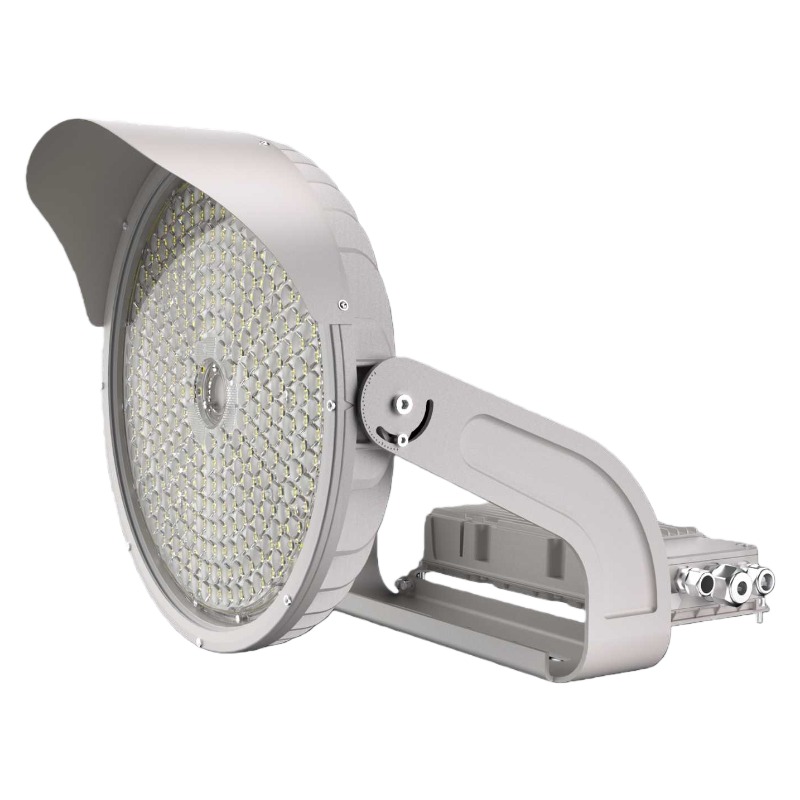
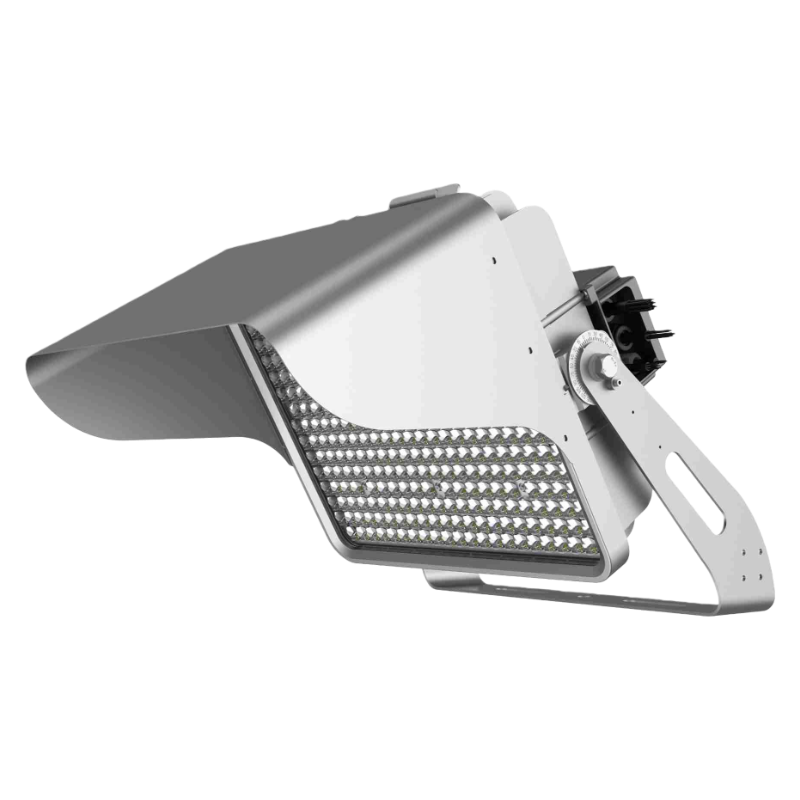
Introduction: Why Structural Mechanics Design Is Non-Negotiable for Stadium Lighting
Stadium lighting is unlike any other lighting application: fixtures are installed at heights of 15-50 meters (grandstands, light towers), exposed to extreme weather (strong winds, heavy rain, snow), subjected to dynamic loads (vibration from crowds, equipment), and must support high-power LED floodlights (200W-1000W) for decades. For these fixtures, "structural mechanics design" isn’t an afterthought—it’s a life-safety and performance-critical discipline. A flawed mechanics design leads to catastrophic risks: fixture collapse, falling debris, unstable illumination (vibration-induced flicker), or premature failure. In contrast, a rigorous structural mechanics design ensures stadium lighting can withstand 50+ mph winds, 50kg snow loads, and years of vibration while maintaining precise light distribution. This blog analyzes the core principles, key design elements, and real-world applications of structural mechanics in stadium lighting—essential knowledge for lighting engineers, stadium managers, and construction teams.
Core Design Principles of Stadium Lighting Structural Mechanics
Stadium lighting’s structural mechanics design adheres to four fundamental engineering principles, tailored to the unique demands of sports venues:
- Safety first: Structural load capacity must exceed maximum expected loads (wind, snow, self-weight) by a safety factor of ≥2.0 (per IEC 60529 and local building codes) to prevent collapse.
- Stability optimization: Minimize structural deformation (deflection ≤L/500, where L is the span) to avoid light beam shift (critical for sports like tennis, where precise illumination is required).
- Durability under harsh conditions: Resist corrosion, fatigue, and environmental aging (UV, humidity) to ensure 15-20 years of service life.
- Integration with lighting performance: Structural design must not obstruct light distribution or add unnecessary weight (which increases load on support structures like light towers).
These principles guide every aspect of structural design, from material selection to connection details.
Key Structural Mechanics Design Elements for Stadium Lighting
1. Load Calculation: The Foundation of Safe Design
Stadium lighting structures must withstand multiple types of loads—accurate calculation is the first step in mechanics design:
- Static loads:
- Self-weight: Weight of the fixture (20-50kg for high-power LED floodlights), mounting brackets, and wiring (0.5-1kg/m).
- Snow load: Dependent on region (e.g., 0.5-2.0 kN/m² in temperate zones, 3.0+ kN/m² in heavy snow areas). For a 1m² fixture surface, 2.0 kN/m² translates to 200kg of snow weight.
- Ice load: Critical for cold regions—ice accumulation adds 10-30% to the fixture’s effective weight (e.g., a 30kg fixture becomes 39kg with 30% ice coverage).
- Dynamic loads:
- Wind load: The most critical dynamic load for high-mounted fixtures. Calculated using wind speed (50-year return period: 30-60 m/s), air density (1.225 kg/m³), and drag coefficient (Cd = 1.2-1.5 for rectangular fixtures). For a 0.5m² fixture at 30m height with 50 m/s wind speed, wind load = 0.5 × 1.225 × 50² × 1.3 = 991 N (≈101 kgf).
- Vibration load: From crowd movement (stadium grandstands), nearby machinery (scoreboards, ventilation), or wind-induced resonance. Design for vibration frequency ≥10 Hz to avoid resonance (which amplifies deformation).
- Impact load: Rare but critical—e.g., debris strike (hail, falling objects) or accidental contact (maintenance equipment). Design for impact energy ≥5J (IK08 rating per IEC 62262).
2. Structural Types: Matching Design to Stadium Layout
Stadium lighting structures are designed based on mounting location (light towers, grandstands, roof edges) and load requirements—three common structural types:
A. Light Tower-Mounted Structures
- Application: Outdoor stadiums (soccer, football) with 20-50m tall light towers.
- Structural design:
- Cantilever arms: Steel or aluminum alloy cantilevers (length 5-10m) extending from the tower. Mechanics focus: Bending resistance (cantilever deflection ≤L/500) and torsional stiffness (to prevent fixture rotation in wind).
- Material: Q235B steel (yield strength 235 MPa) for heavy loads (≥3 fixtures per arm) or 6061-T6 aluminum alloy (yield strength 276 MPa) for lightweight designs.
- Connection: Bolted flange connections (8.8-grade high-strength bolts) with anti-loosening nuts (nylon insert or castellated) to resist vibration.
- Mechanical benchmark: A 8m steel cantilever supporting 3×40kg fixtures must withstand 120kg static load + 150kg wind load—deflection ≤16mm.
B. Grandstand-Mounted Structures
- Application: Indoor/outdoor stadiums with covered grandstands (basketball, volleyball).
- Structural design:
- Horizontal rails: Aluminum or steel rails mounted to grandstand beams, supporting fixtures via sliding brackets. Mechanics focus: Shear resistance (rails must withstand lateral wind loads) and connection strength (brackets bolted to concrete/steel beams).
- Overhang design: For upper grandstands, overhanging brackets (length 2-4m) require moment resistance—reinforced with triangular gussets to distribute loads to the grandstand structure.
- Key consideration: Avoid overloading grandstand beams—structural design must include load distribution calculations (e.g., 4 fixtures per 3m rail, total load ≤5kN/m).
C. Roof-Edge Mounted Structures
- Application: Retractable roof stadiums (baseball, soccer) or indoor arenas.
- Structural design:
- Integrated brackets: Fixtures mounted to roof edge trusses via custom brackets. Mechanics focus: Compatibility with roof structural mechanics (avoid altering truss load paths) and wind uplift resistance (roof-edge fixtures face higher wind speeds).
- Flexible connections: Use rubber vibration isolators to absorb roof movement (e.g., retractable roof operation) and prevent fixture damage.
- Mechanical requirement: Uplift resistance ≥2kN per fixture (to counteract wind suction at roof edges).
3. Material Selection: Balancing Strength, Weight, and Durability
Stadium lighting structures rely on materials with high strength-to-weight ratios and corrosion resistance—key selections:
- Structural metals:
- Steel (Q235B, Q355B): High strength (yield strength 235-355 MPa), suitable for heavy loads (light towers, cantilevers). Requires hot-dip galvanization (≥85μm thickness) + powder coating (≥60μm) for corrosion resistance (salt spray test ≥1000 hours).
- Aluminum alloy (6061-T6, 6063-T5): Lightweight (density 2.7 g/cm³ vs. steel’s 7.85 g/cm³), excellent corrosion resistance, suitable for grandstand/roof-mounted structures. Anodization (≥20μm) enhances durability in coastal areas.
- Connection materials:
- High-strength bolts (8.8/10.9 grade): Tensile strength 800-1000 MPa, used for critical connections (cantilever-tower, bracket-beam).
- Stainless steel (304/316): For coastal stadiums—resists saltwater corrosion. 316 stainless steel (moisture resistance ≥5000 hours) is preferred over 304.
- Auxiliary materials:
- Vibration isolators: Rubber or neoprene (Shore hardness 50-70A) to absorb dynamic loads.
- Thermal insulation: Silicone gaskets to prevent condensation (which can corrode metal connections) in temperature-variable environments.
4. Connection Design: Critical for Load Transfer
Poor connection design is the leading cause of structural failure in stadium lighting—key mechanics considerations:
- Bolted connections:
- Bolt size: M12-M16 bolts for fixture brackets, M20-M24 for cantilever-tower connections.
- Preload torque: 45-60 N·m for M12 bolts, 120-150 N·m for M20 bolts (per ISO 898-1) to ensure tightness.
- Anti-loosening measures: Lock washers (split ring, tooth lock), thread-locking adhesive (Loctite 243), or nylon-insert nuts to resist vibration-induced loosening.
- Welded connections:
- Used for cantilever arms and custom brackets. Weld type: Fillet welds (size ≥6mm) with full penetration.
- Quality control: Ultrasonic testing (UT) to detect weld defects (porosity, cracks) per ISO 9712.
- Fixture-mount connections:
- Slip-fit or clamping brackets with rubber liners to distribute load and prevent fixture damage.
- Torque-limiting fasteners to avoid over-tightening (which can crack fixture housings).
5. Vibration & Fatigue Resistance: Ensuring Long-Term Stability
Stadium lighting structures face repeated dynamic loads (wind, crowd vibration)—fatigue and vibration resistance are critical:
- Vibration control:
- Natural frequency optimization: Design structural components to have natural frequency ≥10 Hz (wind vibration frequency is typically 1-5 Hz) to avoid resonance.
- Damping materials: Add rubber pads between brackets and fixtures to absorb vibration (reduces vibration amplitude by 30-50%).
- Fatigue resistance:
- Material fatigue limit: Steel Q355B has a fatigue limit of 170 MPa (10⁷ cycles), aluminum 6061-T6 has 100 MPa—design load cycles ≤10⁶ to avoid fatigue failure.
- Stress concentration reduction: Round bracket corners (radius ≥5mm) and avoid sharp edges (which increase stress under dynamic loads).
Structural Mechanics Design Standards & Certifications
Stadium lighting structural mechanics design must comply with global standards to ensure safety and reliability:
- International standards:
- IEC 60529: Ingress protection (IP) and mechanical impact (IK) ratings.
- ISO 898-1: High-strength bolt specifications.
- EN 1993 (Eurocode 3): Steel structure design.
- AISC 360: American Institute of Steel Construction standards for steel structures.
- Local codes:
- U.S.: ASCE 7 (wind load calculations), IBC (International Building Code).
- EU: BS EN 12600 (impact resistance), DIN 1055 (snow load).
- China: GB 51348 (stadium lighting design), GB 50009 (load code for building structures).
- Certifications:
- TÜV Rheinland: Mechanical strength and durability certification.
- UL 1598: Safety standard for lighting fixtures (structural integrity).
Real-World Case: Structural Mechanics Design for a 40,000-Capacity Soccer Stadium
- Project scope: Outdoor soccer stadium with 8 light towers (40m tall), each supporting 12×500W LED floodlights (45kg per fixture).
- Structural mechanics design highlights:
- Load calculation: Wind load (50 m/s, Cd=1.3), snow load (1.5 kN/m²), vibration load (10 Hz). Total design load per tower: 12×45kg (self-weight) + 12×100kg (wind) + 200kg (snow) = 2,140kg.
- Structural type: Q355B steel cantilever arms (8m length, 2 arms per tower). Cantilever cross-section: H-shaped steel (300×150×6×8mm) for bending resistance.
- Material & connections: Hot-dip galvanized steel + powder coating (corrosion resistance ≥1500 hours); M24 10.9-grade bolts with thread-locking adhesive.
- Vibration control: Rubber isolators between fixtures and cantilevers (damping ratio 0.2).
- Test results:
- Cantilever deflection under maximum load: 12mm (L/667 ≤ L/500—meets standard).
- Wind vibration test: No resonance at 1-8 Hz; fixture beam shift ≤0.5° (no impact on lighting precision).
- Durability: 10-year simulated corrosion test (salt spray) shows no structural degradation.
Common Structural Mechanics Design Mistakes to Avoid
- Underestimating wind load: Using average wind speed instead of 50-year return period speed—leads to insufficient load capacity.
- Overlooking corrosion: Using uncoated steel in coastal areas—structural failure within 3-5 years.
- Poor connection design: Using low-grade bolts or skipping anti-loosening measures—vibration-induced loosening.
- Ignoring resonance: Structural natural frequency matching wind/vibration frequency—amplified deformation.
- Overloading support structures: Adding too many fixtures to grandstand beams without load calculation—beam deflection or collapse.
Conclusion: Structural Mechanics Design = Safe, Stable Stadium Lighting
The structural mechanics design of stadium lighting is a complex engineering discipline that integrates load calculation, material science, and structural analysis. For stadiums, where safety and performance are non-negotiable, a rigorous mechanics design ensures fixtures withstand extreme weather, dynamic loads, and years of use while maintaining precise illumination. By adhering to core principles, selecting appropriate structural types and materials, and complying with global standards, engineers can create stadium lighting structures that are both safe and durable. For stadium managers and construction teams, understanding these mechanics design elements is essential for selecting reliable lighting solutions and avoiding costly failures. As stadiums evolve (e.g., retractable roofs, higher-capacity venues), structural mechanics design will continue to innovate—ensuring lighting keeps pace with safety and performance demands.