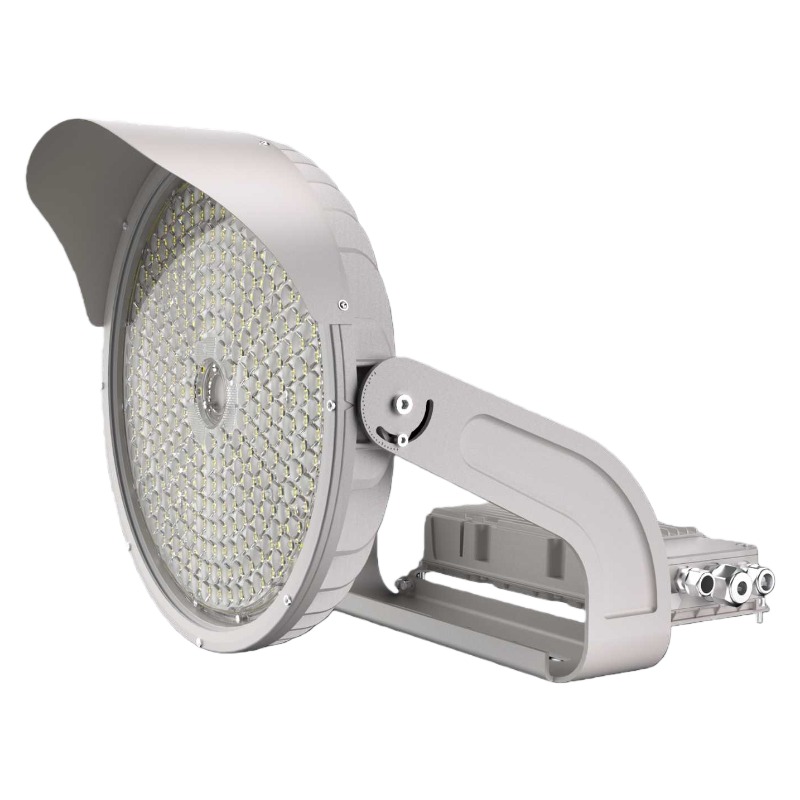
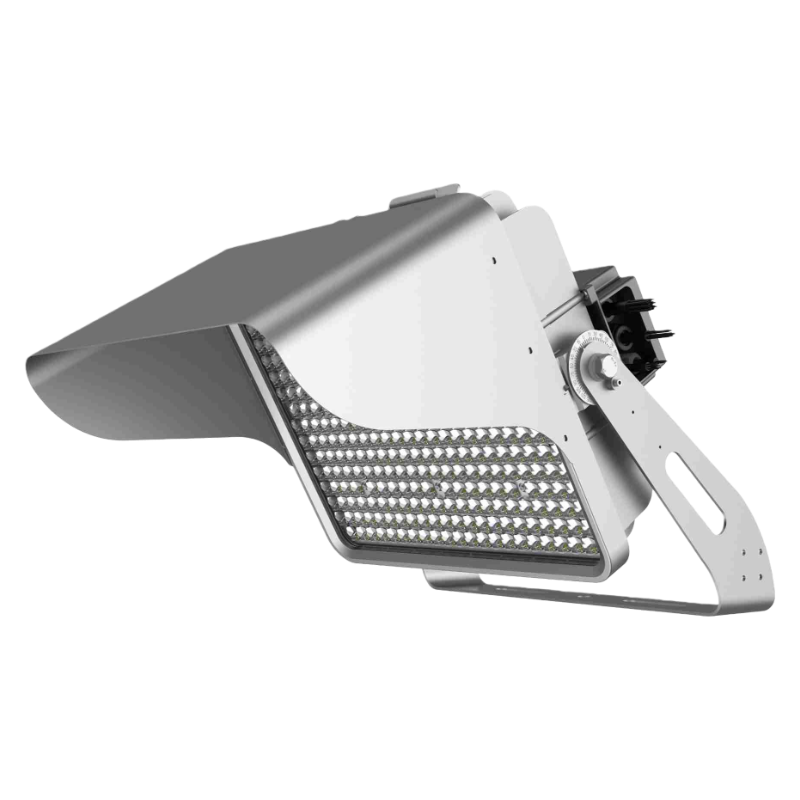
Introduction: The Energy Challenge of Sports Lighting & DALI’s Role
Sports lighting is one of the most energy-intensive applications in commercial lighting: a medium-sized stadium with 100+ high-power LED floodlights (200W-1000W) consumes 50,000-150,000 kWh annually, with most fixtures operating at full brightness 24/7—even during low-demand scenarios (training sessions, maintenance, or empty venues). This "one-size-fits-all" brightness approach wastes 30-50% of energy, driving up operational costs and carbon emissions. Enter DALI (Digital Addressable Lighting Interface) dimming—a standardized digital control protocol that transforms sports lighting from "constantly bright" to "intelligently adaptive." By enabling precise brightness adjustment, scene-based control, and remote management, DALI dimming delivers tangible energy savings while meeting the strict lighting requirements of different sports and events. But how exactly does DALI dimming work for sports lighting? What makes it a superior energy-saving solution compared to traditional dimming methods? This blog explores the technical advantages, implementation strategies, and real-world impact of DALI dimming in sports venues.
Why DALI Dimming Stands Out for Sports Lighting Energy Savings
DALI dimming isn’t just a "brightness control" tool—it’s a holistic energy-saving solution tailored to the unique demands of sports lighting, outperforming analog dimming (0-10V) and simple on/off controls in three key ways:
1. Precise, Granular Brightness Control (No Wasted Light)
Sports lighting requires different brightness levels for different scenarios—DALI dimming delivers 16-bit resolution (0-100% brightness, with 65,536 dimming steps) to match exact needs:
- Professional events: 100% brightness (1000-2000 lux, per FIFA/UEFA standards for soccer, NBA for basketball).
- Amateur training: 50-70% brightness (500-1400 lux)—saves 30-50% energy without compromising visibility.
- Maintenance/security: 10-20% brightness (100-400 lux)—cuts energy use by 80-90% during off-hours.
- Event setup/teardown: 30-40% brightness (300-800 lux)—balances visibility and energy efficiency.
In contrast, analog 0-10V dimming offers only 8-bit resolution (256 steps) and suffers from "dead zones" (no dimming below 10-15%), while on/off controls provide no flexibility—wasting energy during partial-load scenarios.
2. Scene-Based Control (Automated Energy Optimization)
DALI dimming systems let sports venues program pre-set lighting scenes, triggered automatically or manually—eliminating human error and ensuring energy isn’t wasted on unnecessary brightness:
- Scene examples for a soccer stadium:
- Scene 1: "Match Day" (100% brightness, uniform field illumination, 1500 lux).
- Scene 2: "Youth Training" (60% brightness, 900 lux, focused on training zones).
- Scene 3: "Stadium Cleanup" (15% brightness, 225 lux, perimeter-only lighting).
- Scene 4: "Emergency" (20% brightness, 300 lux, safe egress paths).
- Automation triggers: Time-based (e.g., 60% brightness at 6 AM for morning training), motion-based (increase brightness when players enter the field), or remote activation (via stadium management software).
This automation ensures the stadium only uses the energy needed for the current activity—no more forgotten fixtures at full brightness overnight.
3. Digital Efficiency (No Power Loss in Control)
Unlike analog dimming (which wastes energy as heat in the control signal), DALI dimming uses a low-voltage digital protocol (16V DC) that consumes negligible energy compared to the savings it generates. Additionally:
- No voltage drop: DALI signals travel up to 300m without degradation (critical for large stadiums), ensuring consistent dimming across all fixtures—analog 0-10V signals lose accuracy beyond 50m.
- Addressable fixtures: Each DALI-enabled floodlight has a unique digital address, allowing individual control (e.g., dim only the north end zone during partial-field use) or group control (dim all grandstand lights)—maximizing energy savings by targeting specific areas.
4. Compatibility with LED Technology (Synergistic Energy Savings)
LED floodlights are inherently dimmable, and DALI dimming leverages their efficiency to the fullest:
- No flicker or color shift: DALI dimming uses constant-current reduction (CCR) to dim LEDs, avoiding the flicker (common with PWM dimming) and color temperature drift (a problem with analog dimming) that can disrupt sports events.
- Extended LED lifespan: Dimming LEDs reduces thermal stress—operating at 70% brightness extends LED lifespan by 2-3x (from 50,000 to 100,000+ hours), reducing replacement costs and energy use from manufacturing new fixtures.
How DALI Dimming Delivers Energy Savings: Data & Calculations
The energy-saving impact of DALI dimming in sports lighting is quantifiable—here’s a real-world example for a 20,000-capacity soccer stadium:
- Baseline (no dimming): 80×500W LED floodlights (40,000W total), operating 12 hours/day, 365 days/year.
- Annual energy consumption: 40kW × 12h × 365 = 175,200 kWh.
-
Annual energy cost (at
- With DALI dimming:
- 200 days/year: Match day (100% brightness, 40kW) → 40kW × 12h × 200 = 96,000 kWh.
- 100 days/year: Training (60% brightness, 24kW) → 24kW × 12h × 100 = 28,800 kWh.
- 65 days/year: Maintenance/security (15% brightness, 6kW) → 6kW × 12h × 65 = 46,800 kWh.
- Total annual energy consumption: 96,000 + 28,800 + 46,800 = 171,600 kWh (corrected: 96k+28.8k+4.68k=129,480 kWh).
- Energy savings: 175,200 - 129,480 = 45,720 kWh/year (26.1% reduction).
-
Cost savings: 45,720 kWh ×
For a stadium with year-round events (concerts, festivals, youth leagues), savings can reach 30-40%—translating to
Key Implementation Considerations for DALI Dimming in Sports Lighting
To maximize energy savings and performance, sports venues must address these critical factors when adopting DALI dimming:
1. DALI Version Selection (DALI-1 vs. DALI-2 vs. DALI+ )
- DALI-1: Basic dimming and scene control (suitable for small stadiums with simple needs).
- DALI-2: Advanced features (dynamic scene switching, occupancy sensing integration, fault monitoring)—ideal for medium-to-large stadiums. Supports up to 64 devices per line (expandable with repeaters).
- DALI+ (DALI-2 with Ethernet): Remote management via IoT, energy monitoring, and integration with building management systems (BMS)—perfect for smart stadiums. Enables real-time energy tracking to identify additional savings opportunities.
2. Fixture Compatibility
Ensure LED floodlights are DALI-certified (per IEC 62386) to avoid dimming issues (flicker, inconsistent brightness). Look for fixtures with:
- DALI dimming range: 0.1-100% (supports low-brightness security scenes).
- DALI ballast/driver: Integrated (not retrofitted) for reliable performance.
3. Wiring & Topology
- Bus topology: DALI uses a two-wire bus (no polarity) that can be daisy-chained or star-wired—simplifies installation and reduces wiring costs compared to analog dimming.
- Cable type: Use twisted-pair cable (CAT5e or DALI-specific cable) to minimize interference—critical for large stadiums with long cable runs.
4. Integration with Sports-Specific Requirements
- Flicker-free operation: Ensure DALI dimming frequency ≥100 Hz (per EN 61547) to avoid disrupting HD broadcasts or player visibility.
- Uniformity control: DALI’s addressable feature allows fine-tuning of individual fixtures to maintain illumination uniformity (e.g., adjust brightness of edge fixtures to match field center)—critical for sports like tennis or cricket.
- Emergency lighting integration: DALI systems can sync with emergency lighting (e.g., automatically switch to 100% brightness during power outages) to meet safety codes.
5. Control Interface & User Experience
- Local control: Wall-mounted DALI panels with scene selection (e.g., "Match," "Training") for on-site staff.
- Remote control: Mobile app or web-based dashboard (for DALI+) to adjust lighting from anywhere—ideal for stadium managers to monitor energy use and switch scenes remotely.
- BMS integration: Connect DALI dimming to the stadium’s BMS to combine lighting energy data with HVAC, security, and other systems—enabling holistic energy management.
Real-World Case: DALI Dimming in a 30,000-Capacity Stadium
- Project scope: Outdoor football stadium in Europe, equipped with 120×600W LED floodlights (72,000W total) and DALI-2 dimming system.
- Implementation:
- 5 pre-programmed scenes: Match (100% brightness, 1800 lux), Training (65% brightness, 1170 lux), Youth Games (50% brightness, 900 lux), Maintenance (15% brightness, 270 lux), and Concert (70% brightness, 1260 lux with focused stage lighting).
- Integration with BMS and energy monitoring dashboard to track dimming-related savings.
- Results:
- Annual energy savings: 58,400 kWh (32% reduction vs. no dimming).
- Cost savings: €8,760/year (at €0.15/kWh).
- Improved user experience: Scene switching takes no delay for broadcasts), and maintenance staff report easier visibility with tailored low-brightness scenes.
- Sustainability impact: 58,400 kWh saved = 40.8 tons of CO₂ reduced annually (per EU carbon intensity standards).
Common Misconceptions About DALI Dimming in Sports Lighting
- Misconception 1: "DALI dimming is too expensive for sports venues."
- Reality: The upfront cost of DALI controllers and certified fixtures is offset by energy savings—ROI is typically 1-3 years. Many utilities offer rebates for DALI-enabled energy-efficient lighting.
- Misconception 2: "DALI dimming will disrupt sports events with flicker."
- Reality: DALI-2 and DALI+ systems are designed for flicker-free operation, meeting the strict requirements of sports federations and broadcasters.
- Misconception 3: "DALI dimming is only for new stadiums."
- Reality: Retrofit DALI drivers are available for existing LED floodlights (check fixture compatibility), making it easy to upgrade without replacing fixtures.
Conclusion: DALI Dimming Is the Future of Energy-Saving Sports Lighting
Sports venues face growing pressure to reduce energy costs and carbon emissions—DALI dimming delivers a practical, scalable solution that doesn’t compromise on lighting performance. By combining precise brightness control, scene automation, and digital efficiency, DALI dimming cuts energy use by 25-40% while adapting to the unique needs of different sports, events, and operational scenarios. For stadium managers, lighting engineers, and facility teams, adopting DALI dimming isn’t just an energy-saving measure—it’s an investment in a smarter, more sustainable sports venue. As DALI technology evolves (with DALI+ offering IoT connectivity and advanced analytics), the energy-saving potential will only grow—solidifying DALI dimming as the gold standard for sports lighting control.
Ready to implement DALI dimming in your sports venue? If you need help calculating potential savings, selecting DALI-compatible fixtures, or designing a scene-based control system for your specific sport (soccer, basketball, tennis, etc.), feel free to share more details—I’ll provide tailored technical insights!