For facility managers, municipal engineers, and anyone responsible for vast areas like ports, interchanges, or stadiums, high mast lighting is critical infrastructure. The single most important feature of this infrastructure is not just brightness, but reliability over time. Frequent failure at heights of 100 feet or more translates to exorbitant maintenance costs, safety risks, and operational downtime.
This is why the promise of a 100,000-hour or longer lifespan from modern LED high mast lights is revolutionary. But this isn't magic; it's the direct result of deliberate, multi-faceted engineering designed to conquer the enemies of electronic longevity. This article deconstructs exactly how premium LED high mast lights achieve this remarkable endurance.
The Lifespan Metric: Understanding L70, L80, and L90
First, we must define "lifespan." For LEDs, it's not when the light completely fails, but when its light output depreciates to a certain percentage of its original output. Industry standard metrics are:
-
L70: The point at which the fixture emits 70% of its initial lumens.
-
L80: The point at which it emits 80% of its initial lumens.
-
L90 (The Premium Standard): The point at which it still emits 90% of its initial lumens. A 100,000-hour L90 rating means after 100,000 hours of operation, the light will still be at 90% brightness—a barely perceptible change.
The goal of engineering is to push this depreciation curve as far to the right as possible.
The Four Pillars of Longevity: How It's Achieved
Achieving a 20+ year lifespan in a harsh, elevated environment requires a systems-level approach. Here are the four critical engineering pillars:
1. Thermal Management: The Most Critical Factor
Heat is the #1 killer of LEDs. Excessive "junction temperature" at the LED chip accelerates lumen depreciation and can halve the expected lifespan.
-
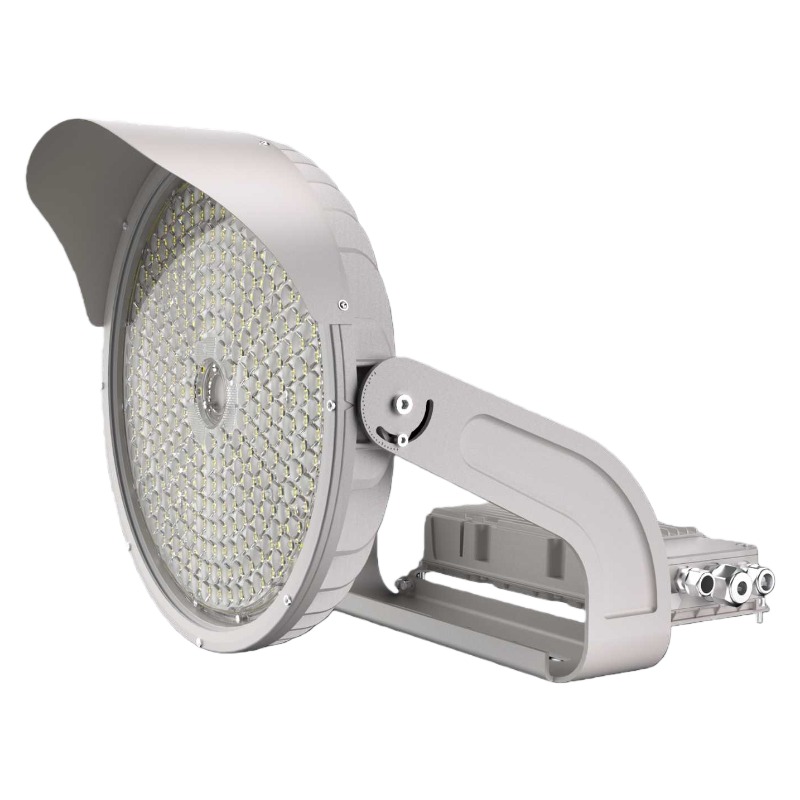
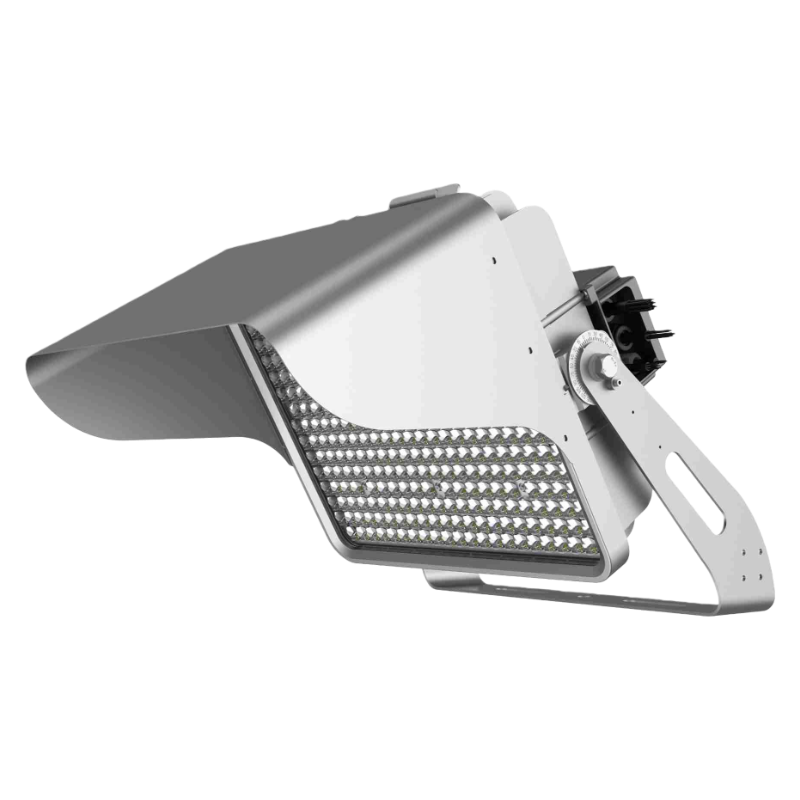
Solution: High-Mass Passive Heat Sinks. Premium high mast fixtures use extruded or die-cast aluminum heat sinks with a massive surface area. This acts as a radiator, passively drawing heat away from the LED module and dissipating it into the air without moving parts (fans) that can fail.
-
Result: By maintaining a low, stable operating temperature (often keeping the LED junction below 85°C even in ambient summer heat), the LED chips degrade at an exceptionally slow rate, directly enabling the 100,000-hour L90 lifespan.
2. Component Quality & Driver Reliability
The LED driver (the power supply) is the second most likely point of failure after thermal issues. A fixture is only as reliable as its weakest component.
-
Solution: Industrial-Grade Drivers. Long-life fixtures use drivers from top-tier manufacturers, rated for 50,000 to 100,000 hours at high temperatures (e.g., Ta 75°C). They feature high-efficiency conversion (≥92%), built-in surge protection (e.g., 10kV), and operate on a wide voltage input (e.g., 100-305V AC) to handle grid fluctuations.
-
Result: A robust power supply ensures stable, clean current to the LEDs, preventing electrical stress and enabling the entire system to meet its lifespan potential.
3. Environmental Protection & Corrosion Resistance
High mast lights are exposed to sun, rain, salt spray, dust, and wide temperature swings. Environmental ingress can quickly destroy electronics.
-
Solution: Superior Sealing & Materials. A minimum ingress protection rating of IP66 (dust-tight, protected against heavy seas or powerful water jets) is standard. For coastal or industrial areas, fixtures should offer a C5-M level anti-corrosion coating on the housing. Optical lenses are made from tempered glass or high-impact, UV-stable polycarbonate that won't yellow.
-
Result: The internal LED engine and driver are completely isolated from the elements, preventing failures caused by moisture, dust, or corrosive salts.
4. Intelligent Control & Reduced Thermal Cycling
Constant on/off switching and operating at full power 100% of the time create unnecessary thermal and electrical stress.
-
Solution: Smart Dimming Capabilities. Fixtures compatible with 0-10V, DALI, or wireless controls can be dimmed during off-peak hours. Dimming to 50% power can reduce thermal load significantly and extend operational life beyond the rated hours.
-
Result: Reduced "thermal cycling" (heating up and cooling down) and lower average operating temperature contribute to even longer effective service life.
The Stark Contrast: LED vs. Traditional HID Technology
The difference in approach and outcome is dramatic when compared to the old technology.
| Aspect | Traditional HID (HPS/MH) High Mast | Long-Life LED High Mast |
|---|---|---|
| Typical Lifespan | 10,000 - 24,000 hours (1-3 years at 24/7) | 100,000+ hours L90 (10+ years at 24/7) |
| Failure Mode | Sudden, complete burnout. Requires immediate, costly replacement. | Gradual, predictable lumen depreciation. Allows for planned maintenance. |
| Maintenance Cycle | Frequent group re-lamping every 1-3 years. High labor, lift, and disposal costs. | Near-zero maintenance for a decade or more. |
| Energy Efficiency | Low efficacy (70-120 lm/W). Significant energy wasted as heat. | High efficacy (140-170+ lm/W). More light per watt, less wasted heat. |
| Light Quality Over Time | Severe color shift and lumen depreciation within the first year. | Stable color temperature and maintained light output (L90). |
Calculating the True Value: Beyond the Bulb
The financial impact of a long lifespan is profound:
-
Eliminated Maintenance Costs: A single high mast service requiring a crane or bucket truck can cost thousands of dollars. Eliminating 4-5 such services over 10 years saves tens of thousands.
-
Energy Savings Compounded: The 60%+ energy savings are enjoyed over a much longer period, multiplying the total dollar savings.
-
Reliability & Safety: Consistent, high-quality light ensures safety and security without unexpected dark zones from failed fixtures.
Conclusion: An Investment in Predictable Performance
A long-lifespan LED high mast light is a capital investment in predictable performance, not a recurring consumable expense. The engineering principles—superior thermal management, component quality, environmental sealing, and smart operation—work in concert to deliver on the promise of decades of reliable, efficient illumination.
When specifying high mast lighting, looking beyond the initial lumens and wattage to the L90 lifespan rating and the engineering details that support it is the key to achieving the lowest total cost of ownership and uninterrupted operations for your most critical large-area lighting applications.