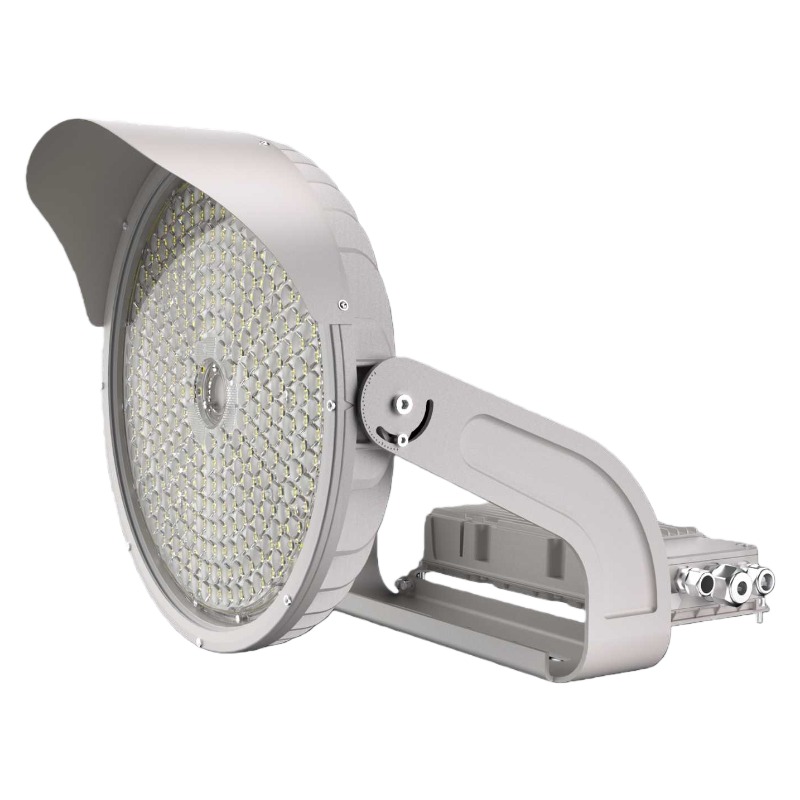
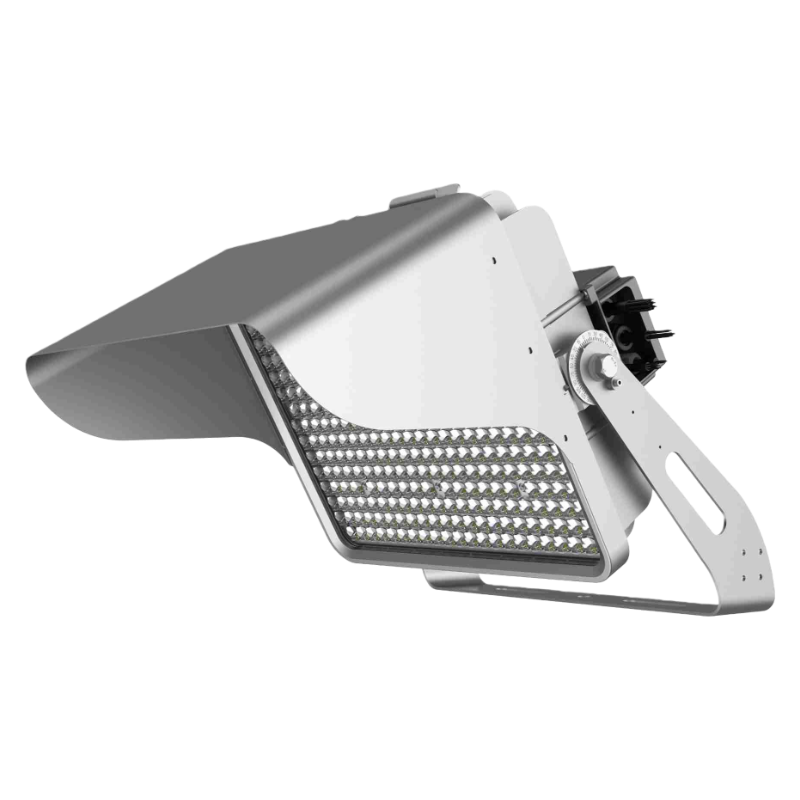
500W vs 1000W LED Sports Lights: Which Should You Choose?
Introduction
Choosing between a 500W LED sports light and a 1000W LED sports light isn‘t as straightforward as picking the higher number. In 2026, LED technology has advanced to the point where a 500W fixture can often match—or even outperform—a legacy 1000W metal halide while using 60‑70% less energy.
The right wattage for your stadium or athletic field depends on a complex set of factors: field dimensions, competition level (Class I professional vs. Class III high school), mounting height (60–100+ feet), broadcast requirements (4K flicker‑free standards), beam angle selection, and total lumens required to achieve the target illuminance.
This comprehensive guide breaks down everything you need to make an informed decision between 500W and 1000W LED sports lights. We‘ll compare actual lumen output (not just wattage), list the fixture counts needed by sport and IES lighting class, analyze upfront and operational costs, explain DLC V6.0 compliance for rebate eligibility, and provide real‑world case studies. By the end, you’ll know exactly which wattage is right for your facility—and how to avoid costly over‑sizing or under‑illumination mistakes.
The Critical Mistake: Choosing Wattage Over Lumens
Before we compare 500W versus 1000W, let‘s correct the biggest misconception in stadium lighting: wattage measures power consumption, not brightness.
Traditional metal halide (MH) fixtures had consistent efficiency (~60–80 lm/W), so a higher‑wattage bulb was reliably brighter. But LED technology has changed the game entirely. Efficiency varies dramatically across manufacturers and product lines.
| Technology | Wattage | Lumens | Efficacy (lm/W) |
|---|---|---|---|
| Metal halide (legacy) | 1000W | 60,000–80,000 | 60–80 |
| Standard LED | 400W | 60,000 | 150 |
| High‑efficiency LED | 300W | 45,000 | 170 |
A premium 500W LED with 180 lm/W delivers 90,000 lumens—while a budget 1000W LED with only 120 lm/W delivers just 120,000 lumens. The 1000W unit consumes twice the electricity but produces only 33% more light. Higher wattage does not always mean brighter, more efficient, or better value.
The key metrics for stadium lighting are:
-
Lumens: Total light output of the fixture
-
Illuminance (lux or foot‑candles): Light actually reaching the field surface
-
Uniformity ratio (U₀): Evenness of light distribution across the playing area
-
Wattage: Secondary factor for estimating energy use and fixture size.
Always prioritize lumens and lux requirements first, then use wattage as a secondary metric.
Modern Efficacy: What‘s Possible in 2026
In 2026, industry‑leading LED stadium lights achieve 150–180 lm/W stabilized efficacy, with premium models reaching up to 180 lm/W or more. This efficiency leap has fundamentally changed stadium lighting economics: a 600W LED can outperform a legacy 1500W metal halide lamp while reducing grid demand by over 60%. Using Lumileds 5050 SMD chips with 10°‑60° beam options, premium 1000W LED floodlights can illuminate an entire football pitch while meeting FIFA’s 1500–2000+ lux broadcast standards.
Side‑by‑Side Comparison: 500W vs 1000W LED Sports Lights
| Comparison Factor | 500W LED Sports Light | 1000W LED Sports Light |
|---|---|---|
| Typical Lumens (150 lm/W) | 75,000 lumens | 150,000 lumens |
| Typical Lumens (180 lm/W premium) | 90,000 lumens | 180,000 lumens |
| Equivalent Metal Halide Replacement | Replaces 800–1500W MH | Replaces 1500–3000W MH |
| Ideal Competition Level | High school, amateur, training | Professional, broadcast (Class I) |
| Recommended IES Class | Class III–II (30–80 fc) | Class I–II (50–150+ fc) |
| Typical Pole Height | 40–60 ft (12–18m) | 60–100+ ft (18–30m) |
| Beam Angles Best Suited | 45°–90° (medium‑wide) | 10°–45° (narrow‑medium) |
| Annual Energy Cost (4,000 hrs @ $0.12/kWh) | ~$240 per fixture | ~$480 per fixture |
| Mounting Structure Requirements | Lighter, less wind load | Heavier, reinforced structure |
| Typical Applications | Community fields, high school football, baseball fields | College stadiums, professional leagues, broadcast venues |
| DLC V6.0 Premium Eligibility | Yes—with 140+ lm/W | Yes—with 140+ lm/W |
| Control Compatibility | 0‑10V, DALI, DMX512 | 0‑10V, DALI, DMX512, plus advanced zoning |
When to Choose 500W LED Sports Lights
A 500W LED fixture is a versatile workhorse for smaller and mid‑tier sports venues.
Best‑fit applications:
-
High school football fields (IES Class III, 30–50 fc): For a typical high school stadium, 32 pieces of 500W LED lights on 4 poles (60 ft height) deliver approximately 42–60 fc average. That exceeds the IES Class III requirement while keeping power consumption and installation costs modest.
-
Baseball and softball fields (IES Class III, 50/25 fc infield/outfield): 500W fixtures spaced appropriately on 4–6 poles achieve the required 2:1 infield‑to‑outfield ratio.
-
Small community soccer fields (200–300 lux): A 500W LED training field solution can cover FIFA training standards using fewer than 20 fixtures. For soccer fields demanding 300 lux, two 500W poles with 12 fixtures per pole produce consistent illumination without the expense of 1000W units.
-
Youth and recreational multi‑purpose fields: Low‑wattage solutions reduce operational costs while meeting safety requirements for younger athletes and non‑televised play.
For a 500W LED fixture with 150 lm/W delivering 75,000 lumens, a typical training soccer field needs total lumens of approximately 800,000 to 1,200,000—meaning 10‑16 fixtures total. With premium 180 lm/W fixtures (90,000 lumens each), you could achieve the same illuminance with even fewer units.
Real‑world fixture‑count examples:
-
High school football stadium (IES Class III, 40 fc): 32 units of 500W LEDs
-
Little League baseball (IES Class III, 30/15 fc): 8–12 units of 500W LEDs
-
Community soccer practice field (200 lux): 12–16 units of 500W LEDs
When to Choose 1000W LED Sports Lights
A 1000W LED sports light is the professional standard for large venues, televised events, and facilities requiring maximum vertical illuminance.
Best‑fit applications:
-
Professional football stadiums (IES Class I, 100–150 fc, broadcast‑ready): Why is the 1000W LED floodlight the first choice for professional football stadiums? It simultaneously meets all demanding requirements: players need a clear, glare‑free view; spectators expect bright, uniform illumination; broadcasters require flicker‑free, high‑definition images; and facility operators want energy savings, durability, and low maintenance. When a 1000W LED floodlight can meet all these requirements at once, it becomes a complete sports lighting system. To achieve the same illuminance standard (e.g., FIFA 1500–2000 lux for professional play), a 1000W LED system reduces fixture count by 30–50% compared to 500W designs, and overall energy consumption is cut by more than 50% relative to traditional metal halide.
-
College and NCAA stadiums (IES Class II, 50–100 fc): As stadium size increases to NCAA Division I standards, 1000W LEDs provide the elevated lux and uniformity (U₀ ≥ 0.7) required for evening games and video replay systems.
-
4K/8K broadcast venues: With flicker‑free high‑frequency modulation and TLCI > 90, premium 1000W LED fixtures eliminate the “strobe effect“ in ultra‑slow‑motion replays up to 1,000 fps, fully complying with 4K/8K broadcast requirements.
-
High‑mast installations (80–120+ ft poles): For the tallest stadium structures, narrow‑beam (10°–25°) 1000W fixtures project light efficiently from long distances, focusing illumination precisely where it’s needed.
-
Professional baseball parks (IES Class I, 150/75+ fc infield/outfield): A 1000W system with 8+ poles (40–50 fixtures) meets MLB’s 2:1 infield‑outfield ratio and supports both evening broadcasts and challenging vertical angles (pop flies and home run tracking).
Real‑world fixture‑count examples:
-
Professional football stadium (IES Class I, 150 fc): 80–120 units of 1000W LEDs
-
NCAA Division I baseball field (70/35 fc): 24–32 units of 1000W LEDs
-
FIFA‑compliant soccer stadium (1500+ lux): 42–48 units of 1000W LEDs
Calculating Your Required Lumens: The Lumen Method
To determine whether 500W or 1000W fixtures are appropriate for your field, use the Lumen Method formula:
Total Lumens Required = Area (m²) × Target Illuminance (lux)
Then divide by the lumens per fixture to find the number of fixtures needed.
| Field Size (approx.) | Training (200‑300 lux) | High School (500‑800 lux) | College (800‑1500 lux) | Professional (1500‑2000+ lux) |
|---|---|---|---|---|
| Small (50m × 30m = 1,500㎡) | 500W (10‑12 fixtures) | Not applicable | Not applicable | Not applicable |
| Medium (100m × 60m = 6,000㎡) | 500W (20‑30 fixtures) | 500W (30‑40 fixtures) or 1000W (15‑20 fixtures) | 1000W (20‑30 fixtures) | Not typical |
| Large (110m × 75m = 8,250㎡) | 500W (30‑40 fixtures) | 500W/1000W hybrid (40+ fixtures) | 1000W (40‑60 fixtures) | 1000W (60‑80+ fixtures) |
For a soccer field requiring 500 lux: approximately 42–48 fixtures of 600W each (or 20‑25 fixtures of 1200W) are needed.
For a professional football stadium requiring 1500+ lux: a Chinese Super League stadium uses 270 units of 1500W LED stadium lights to achieve over 1800+ lux horizontal illuminance with 0.90 uniformity—meeting FIFA broadcast standards for international matches.
This illustrates that the right choice isn‘t strictly 500W vs. 1000W—higher wattages (1200W, 1500W, 2000W) are sometimes necessary for the largest broadcast venues.
Beam Angle Considerations: Narrow vs. Wide for Each Wattage
Beam angle dramatically impacts field coverage and fixture count. A 500W fixture with a wide beam might cover the near zone well but fail to illuminate the far sidelines. A 1000W fixture with a narrow beam can project light across the entire field from a single corner pole.
Beam angle reference guide:
-
10°–25° (Narrow): Long‑distance projection for 1000W fixtures on high‑mast poles (80+ ft), center field coverage from perimeter poles.
-
25°–45° (Medium): Mid‑field coverage for 500W/1000W fixtures in multi‑pole layouts (6‑ or 8‑pole configurations).
-
45°–90° (Wide): Sideline and corner coverage for 500W fixtures at lower mounting heights; edges and running tracks.
Professional tip: Most stadiums mix narrow and wide beams on the same poles to achieve optimal uniformity. A typical layout uses narrow beams for the center field, medium beams for the mid‑field, and wide beams for near‑field edge coverage.
Cost Analysis: Upfront and Operating Costs
| Cost Factor | 500W LED (×60 fixtures) | 1000W LED (×30 fixtures) | Notes |
|---|---|---|---|
| Fixture purchase (premium 170 lm/W) | 60 × 18,000 | 30 × 18,000 | Similar total fixture cost |
| Annual energy (4,000hr @ $0.12/kWh) | 60 × 2,000 kWh = 120,000 kWh × 14,400 | 30 × 4,000 kWh = 120,000 kWh × 14,400 | Identical energy cost—doubling fixture count with half wattage yields same total power draw |
| Maintenance (10 years) | ~$2,000 (cleaning only) | ~$1,500 (cleaning only) | LED = near‑zero maintenance for both options |
| Installation labor | Higher (more fixtures to mount and aim) | Lower (fewer fixtures) | 500W requires more installation labor and time |
| Pole reinforcement | Lighter load = minimal reinforcement | Heavier load = may require reinforcement | 1000W fixtures are heavier, impacting structural design |
| DLC V6.0 Premium rebates (estimated) | 150 per fixture | 300 per fixture | Higher per‑fixture rebates for 1000W (but fewer fixtures) |
Key insight: For a given target illuminance, the total system wattage (number of fixtures × wattage per fixture) is roughly fixed. Choosing 500W over 1000W means roughly doubling the fixture count—which increases installation labor, adds more aiming points, and complicates maintenance access, but distributes weight more evenly and can improve uniformity in certain layouts.
IES Lighting Standards: Matching Wattage to Competition Level
The Illuminating Engineering Society‘s ANSI/IES RP‑6‑24 (2025) guidelines remain the most widely referenced document for sports field lighting in North America. RP‑6‑24 includes updated illuminance levels and places a stronger emphasis on vertical illuminance to help players and cameras read faces, numbers, and fast‑moving objects, while focusing on glare control, limiting light trespass, and protecting the night sky.
IES Sports Lighting Class System (ANSI/IES RP‑6‑24):
| IES Class | Level of Play | Horizontal fc | U₀ Uniformity | UGR Limit | Recommended Wattage |
|---|---|---|---|---|---|
| Class I | Professional / Broadcast | 100–150+ fc | ≤ 1.5:1 | < 19 | 1000W–1500W+ |
| Class II | College / Regional | 50–100 fc | ≤ 2.0:1 | < 22 | 800W–1200W |
| Class III | High School / Recreational | 30–50 fc | ≤ 2.5:1 | ≤ 22 | 400W–800W |
| Class IV | Training / Social Play | 10–30 fc | ≤ 3.0:1 | — | 200W–400W |
Ultra‑High Output Applications: Cases Where 1000W Excels
For the most demanding venues—professional broadcast and 4K/8K live streaming—1000W LED fixtures often outperform multiple 500W configurations.
FIFA‑compliant professional football:
Using a professional football stadium LED floodlight as a complete sports lighting system:
-
Single 1000W floodlight (150 lm/W) = 150,000 lumens
-
Optimal beam angles (10° for far‑field, 25° for center‑field, 45° for mid‑field)
-
Multiple beam angle configuration on each mast → overall uniformity >0.7
-
Professional anti‑spill light shield→ eliminates light pollution, critical for urban stadium environmental compliance
-
FIFA–compliant 1500–2000+ lux with flicker‑free (TLCI >90) and UGR <19 for broadcast
-
Result: To achieve the same illuminance standard (e.g., FIFA 200–500 lux for training), the number of LED fixtures can be reduced by 30–50%, and overall energy consumption is cut by more than 50%
Broadcast Specifications: CRI, CCT, TLCI, and Flicker
Whether choosing 500W or 1000W fixtures, broadcast venues require premium performance:
-
CRI (Color Rendering Index): Minimum 80 for high school/college; ≥ 90 recommended for professional broadcast
-
CCT (Correlated Color Temperature): 5000K–5700K is standard for outdoor sports, mimicking natural daylight for true‑to‑life camera reproduction
-
TLCI (Television Lighting Consistency Index): >85 minimum for HDTV; >90 required for 4K/8K slow‑motion
-
Flicker‑free operation: High‑frequency drivers (<3% flicker, premium models <1%) ; IEEE 1789‑2015 compliant
DLC V6.0 Compliance: Critical for 2026 Rebates
In 2026, DLC certification is not optional—it’s your gateway to utility rebates.
Important 2026 deadlines: DLC SSL V6.0 became active in early January 2026. The policy increases the minimum efficacy threshold for DLC‑listed products by an average of 14% across all product types, with some product efficacy increases as high as 19%. Premium V6.0 products must meet stricter controllability and efficacy criteria.
For both 500W and 1000W fixtures:
-
V5.1 products will be delisted on October 1, 2026, and removed from the QPL. After December 15, 2026, V5.1 products no longer qualify for rebates.
-
Specify DLC V6.0 Premium certified fixtures for full rebate eligibility
-
Rebates typically range from 300+ per fixture depending on wattage and tier
-
Work with your supplier to identify available local utility incentives before purchasing
Environmental and Structural Considerations
500W advantages:
-
Lighter weight → reduces pole reinforcement requirements
-
Easier handling on lifts → faster installation
-
More flexible for retrofitting older pole structures
-
Lower wind load in hurricane‑prone regions
1000W advantages:
-
Fewer fixtures → reduced labor for installation and maintenance
-
More compact control system (fewer control points)
-
Superior long‑throw coverage for very large venues
-
Simpler zoning (larger zones with fewer points to program)
Case Study: Cost of a 100,000+ Lumen Professional Stadium
A high school football stadium field project aiming for ~40 fc (IES Class III, roughly 40 foot‑candles) might use 32 pieces of 500W LED stadium lights on 4 x 60 ft poles. Alternatively, the same illuminance could be achieved with 16–20 pieces of 1000W lights on the same 4 poles.
500W configuration:
-
Fixture cost (32 × 12,800
-
Installation labor (approx. 3‑4 days with 2 electricians) = 6,000
-
Total project = 19,000
1000W configuration:
-
Fixture cost (16 × 12,800
-
Installation labor (approx. 2 days with 2 electricians) = 3,000
-
Total project = 16,000
Verdict: For the same total system lumens and illuminance, 1000W often reduces total installed cost due to lower labor, despite having similar raw fixture expense.
10‑Step Decision Framework
Use this decision‑making flowchart:
-
Determine field dimensions – Measure length and width in meters or feet.
-
Identify your IES lighting class – Is it Class I (broadcast), Class II (college), Class III (high school), or Class IV (training)?
-
Establish target lux/foot‑candles – Based on IES RP‑6‑24 and your sport requirements.
-
Calculate total lumens required – Use the Lumen Method: Area (m²) × Target lux.
-
Evaluate mounting height – Poles under 50 ft → 500W may suffice; poles over 60 ft → consider 1000W.
-
Assess pole structural capacity – Older or lightweight poles → lower‑wattage fixtures.
-
Consider broadcast requirements – 4K/8K or slow‑mo → high CRI (>90) and flicker‑free (TLCI >90) → likely 1000W.
-
Estimate total number of fixtures – Total lumens ÷ lumens per fixture.
-
Compare total installed cost – Include fixtures, installation labor, pole reinforcement, controls, and maintenance.
-
Request a professional photometric design – Run AGi32 or Dialux simulations before ordering any hardware.
Frequently Asked Questions (FAQ)
Q: Can a 500W LED sports light be bright enough for professional broadcast?
A: Generally, no. Professional broadcast (especially 4K/8K) requires high vertical illuminance and flicker‑free performance typically associated with 1000W+ fixtures. However, a premium 500W LED with 180 lm/W (90,000 lumens) can be bright enough for smaller professionally televised venues (e.g., tennis courts) if paired with high pole density.
Q: How do I know if my field needs 500W or 1000W lights?
A: Use the decision framework above. Quick rule of thumb: If your field is under 7,000 m² (75,000 sq ft) and you only play high school or recreational sports, 500W is likely sufficient. For fields over 8,000 m² (85,000 sq ft) or any televised events, strongly consider 1000W.
Q: How does efficacy (lm/W) affect the 500W vs 1000W decision?
A: Massively. A 500W LED with 180 lm/W (90,000 lumens) actually outperforms a 1000W LED with 120 lm/W (120,000 lumens) on a per‑watt basis. When comparing, normalize fixtures by their lumens per fixture—not their stated wattage. Always ask for the lm/W specification.
Q: What’s the energy cost difference per fixture between 500W and 1000W?
A: Assuming 4,000 hours/year and 240 per fixture annually; 1000W = ~$480 per fixture annually. But remember: you‘ll typically need more 500W fixtures to achieve the same illuminance as fewer 1000W fixtures, so total system energy cost is often comparable.
Q: Do 1000W LEDs require special electrical infrastructure?
A: Usually, no—most LED sports lights operate on 100‑277V AC, the same as standard commercial circuits. However, high‑output 1000W units may require heavier gauge wiring and dedicated circuits, especially if many fixtures are grouped on one pole. Check your panel capacity before ordering.
Final Summary: 500W vs 1000W LED Sports Lights
Choosing between 500W and 1000W LED sports lights in 2026 isn‘t about which wattage is “better“—it’s about matching wattage to your specific venue requirements.
Choose 500W LED sports lights when:
-
Your field is smaller or mid‑sized (under 75,000 sq ft)
-
Competition level is IES Class III (high school) or Class II (college) without broadcast
-
You’re on a tighter installation budget (fewer fixtures required for medium fields)
-
Pole height is 40‑60 ft and structural capacity is limited
Choose 1000W LED sports lights when:
-
Your venue is IES Class I (professional broadcast) with 4K/8K television requirements
-
Field dimensions exceed 8,000 m² (85,000 sq ft)
-
Mounting height exceeds 60 ft (high‑mast installations)
-
Vertical illuminance demands exceed 30‑50% of horizontal targets
-
You want to minimize fixture count and simplify maintenance
Always prioritize lumens, not wattage. A premium 500W LED (180 lm/W) is a formidable lighting tool, but the highest‑output 1000W fixtures (also 150–180 lm/W) remain the standard for the world’s largest, most demanding sports venues.